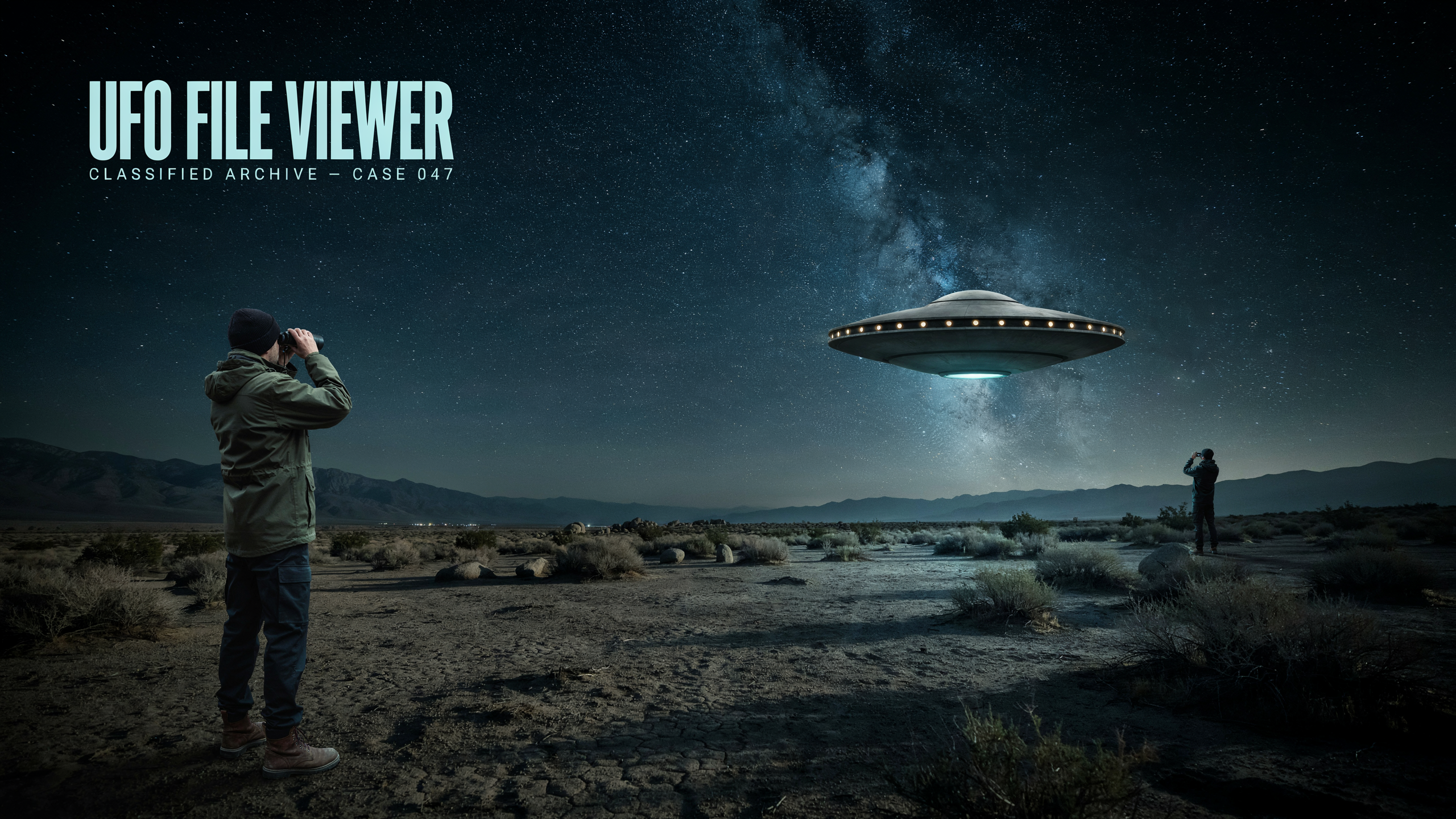
America’s most mysterious UFO encounters include Kenneth Arnold’s 1947 sighting, the Roswell debris, the 1952 Washington radar reports, the Hills’ abduction account, the Allagash claims, and the 1997 Phoenix Lights. Witnesses, photographs, radar contacts, and government files document what people reported, but they do not establish extraterrestrial origins. Investigators have considered ordinary explanations, including weather, aircraft, and balloons, while some details remain unresolved. The UFO File Viewer presents the cases that follow as a look at what the historical record confirms—and what it cannot settle. Explore them with the UFO File Viewer.
What Makes a UFO Encounter Mysterious?
A UFO encounter is mysterious not merely because a witness cannot identify what they saw, but because the available evidence resists a clear explanation. Unidentified aerial phenomena become historically significant when testimony, records, or physical traces remain inconclusive after careful review. A bright light, unusual motion, or unfamiliar shape may have ordinary causes, including aircraft, atmospheric effects, or mistaken perception. Yet an encounter can remain unresolved when observations are consistent, instruments provide limited data, or records are incomplete.
Investigators distinguish what witnesses reported from what evidence can establish. They compare accounts, assess viewing conditions, consult aviation and weather records, and note uncertainty rather than treating speculation as fact. The Extraterrestrial hypothesis is one possible interpretation, but an unexplained observation alone does not demonstrate an off-world origin. Responsible inquiry consequently preserves evidence, respects witnesses, and communicates limits plainly. Such care serves the public by reducing misinformation while leaving room for new evidence to revise conclusions. Under these circumstances, mystery marks an evidentiary gap, not proof of extraordinary claims.
Kenneth Arnold’s 1947 UFO Sighting
On June 24, 1947, aviator Kenneth Arnold reported seeing nine bright objects while flying near Mount Rainier in Washington. Arnold said they moved rapidly in formation, describing their motion as saucers skipping across water. Newspapers soon popularized “flying saucer,” though Arnold’s comparison concerned movement, not necessarily shape.
Arnold’s description captured the objects’ motion, while newspapers turned his comparison into a lasting name.
The Mount Rainier sighting became an early landmark in postwar reports of unidentified flying objects. Investigators have considered Arnold’s account, weather conditions, and possible misidentifications, but no explanation has been established conclusively. His report documents what he said he observed; it does not, by itself, identify the objects or prove an extraordinary origin.
Three details help place the episode in context:
- Arnold was an experienced private aviator searching for a missing aircraft.
- He estimated the objects’ speed at roughly 1,700 miles per hour, a figure difficult to verify from his vantage point.
- His account helped prompt public reporting and official scrutiny of unexplained aerial observations.
Careful inquiry distinguishes testimony, contemporary records, and later interpretation, while respecting witnesses and uncertainty.
Roswell: The Crash and Cover-Up Claims
In July 1947, a rancher near Roswell, New Mexico, reported finding scattered debris, and the nearby Army airfield briefly announced the recovery of a “flying disk.” The military soon revised its account, identifying the material as debris from a weather balloon; decades later, the Air Force said it came from a classified balloon program. The shifting explanations fueled claims of a crash retrieval and official concealment. Rancher testimony and later interviews described unusual foil, sticks, and other fragments, but recollections varied and were recorded years after the event. In 1994, the Air Force linked the debris to Project Mogul, a secret effort to detect Soviet nuclear tests using high-altitude balloons. Its classified debris analysis offered a documented explanation for the initial secrecy, while acknowledging that the first public statement was inaccurate. No independently verified evidence has established an extraterrestrial craft or recovered bodies. Roswell remains a case study in how secrecy, changing accounts, and incomplete records can sustain public suspicion.
The 1952 Washington, D.C., UFO Sightings
In July 1952, radar operators at Washington National Airport and Andrews Air Force Base reported unexplained contacts over the capital. Air Force investigations attributed many returns to temperature inversions, while aviators also reported lights they could not identify. The episode prompted public scrutiny of how the military assessed and explained the sightings.
Radar Contacts Over Washington
A series of unexplained radar returns over Washington, D.C., in July 1952 drew national attention and prompted an Air Force investigation. Controllers at Washington National Airport and Andrews Air Force Base tracked targets whose positions and speeds appeared unusual. Reports from aircrew added urgency, but radar evidence alone could not establish that the objects were physical craft.
- On July 19, controllers observed radar signal anomalies near the capital, while visual sightings were reported by aircrew and residents.
- Operators at separate facilities detected returns, though atmospheric conditions could produce misleading echoes.
- On July 26, similar contacts reappeared, creating air traffic coordination challenges as controllers monitored civilian flights and sought clarification.
The records document a genuine operational puzzle, not a settled explanation. Distinguishing equipment effects, weather, and unidentified targets remains vital to an accurate account of the episode.
The Air Force Response
As the radar reports drew national attention, the Air Force investigated the Washington sightings and publicly addressed the uncertainty surrounding them. Military investigations examined radar conditions, weather, and witness accounts after unexplained targets appeared over the capital in July 1952.
| Evidence | Air Force review | Public relevance |
|---|---|---|
| Radar returns | Checked for anomalies | Clarified limits |
| Visual reports | Compared with radar | Respected witnesses |
| Temperature inversions | Considered as explanation | Explained possible effects |
At a July 29 press conference, officials described a temperature inversion as a possible cause of radar echoes, while acknowledging that the explanation did not resolve every report. Captain Edward Ruppelt later said the Air Force had not established a definitive answer. These public statements sought to reassure residents and support informed discussion, but uncertainty persisted. The response reflected an effort to investigate claims systematically without presenting speculation as settled fact.
The Hills’ 1961 Abduction Account
On the night of September 19–20, 1961, Betty and Barney Hill reported seeing a strange light while driving through New Hampshire’s White Mountains, an encounter that later became one of the best-known alleged UFO abductions in the United States.
In 1961, Betty and Barney Hill reported a strange light in New Hampshire’s White Mountains, beginning a famous UFO abduction account.
The couple described a close approach, then a gap in their recollection and unexplained marks on their car. Under psychiatric care, they underwent hypnosis; Betty and Barney Hill later recounted being taken aboard a craft and examined by nonhuman beings. Their account entered public discussion through interviews, a 1966 newspaper story, and John G. Fuller’s 1966 book, The Interrupted Journey.
Three details shaped the case’s lasting debate:
- The Hills’ initial reports did not include a complete abduction narrative.
- Hypnotic sessions produced memories, but hypnosis can increase confidence without verifying accuracy.
- Investigators found no physical evidence establishing that an abduction occurred.
The phrase alien hypnosis became associated with the case, though it describes a method of memory retrieval, not proof. The account remains significant as testimony, not confirmed evidence.
The 1965 Exeter UFO Sightings
In September 1965, reports of a large, low-flying object with bright lights drew national attention to Exeter, New Hampshire. On September 3, teenager Norman Muscarello reported seeing a silent, glowing object near a rural road. Police officers Eugene Bertrand and David Hunt later described observing a similar object, whose lights appeared to change intensity and color.
The case gained attention partly because the witnesses were identified and interviewed soon after the events. Their accounts supported witness credibility, though testimony alone could not establish the object’s identity. Local investigations included police reports and interviews, while journalists and researchers examined whether aircraft, stars, or other familiar sources could explain the sightings.
The Air Force’s Project Blue Book reviewed the reports and proposed that the witnesses had seen a KC-97 tanker aircraft. That explanation remained disputed by some investigators, who questioned whether the aircraft matched the reported appearance and movements. Exeter illustrates how careful documentation can clarify evidence without resolving every uncertainty.
Michigan’s 1966 “swamp Gas” Sightings
Unlike the Exeter reports, Michigan’s 1966 sightings became closely associated with an official explanation that drew public skepticism. On March 20, residents near Dexter reported lights moving over marshland; days later, university campus sightings at Hillsdale College prompted further investigation. Witnesses described luminous objects changing color and position, while police officers also reported unusual lights.
The Air Force sent astronomer J. Allen Hynek to examine the reports. After considering conditions at the marsh, he suggested “swamp gas”—methane from decaying vegetation—as a possible explanation. The phrase quickly became shorthand for dismissing unexplained observations, although Hynek later acknowledged that the evidence did not support certainty.
- Michigan witness interviews recorded differing descriptions, complicating efforts to identify one shared source.
- Weather, distance, and nighttime visibility limited reliable identification.
- The official account eased neither public concern nor questions about the investigation.
The episode illustrates why careful listening, transparent methods, and respect for witnesses matter when authorities assess uncertain events.
The 1969 Berkshire UFO Incident
In September 1969, residents across Berkshire County, Massachusetts, reported seeing an unusual object in the sky. Their accounts, gathered years later through interviews and local records, describe encounters in several towns but vary in detail. The incident’s aftermath has kept questions about the reports’ timing, consistency, and possible explanations in circulation.
The Berkshire Sightings
What happened in the Berkshires on the night of September 1, 1969? Reports from western Massachusetts describe an unusual object moving across the region, though no contemporaneous official record has established its identity. The episode later entered local folklore, shaped by the area’s rural communities and regional geography, where hills, valleys, and scattered towns complicated observation and comparison.
- Setting: Accounts place the reported activity across several Berkshire County locations, rather than at one confirmed site.
- Context: The date fell during a period of widespread public interest in unidentified flying objects, making careful separation of observation from interpretation crucial.
- Evidence: Available historical material consists largely of later recollections and local reporting; no independently verified physical evidence has settled what occurred.
The incident remains a regional mystery, best approached through documented sources and respectful attention to community history.
Witness Accounts and Aftermath
Later accounts of the September 1, 1969, Berkshire sightings describe witnesses seeing an unusual object from different locations, but the details vary and were recorded years after the event. Reports from Sheffield, Great Barrington, and nearby towns include claims of a bright craft, missing time, and apparent movement between locations. These recollections gained wider attention decades later, when witnesses shared stories publicly and researchers collected interviews. Their consistency on a striking encounter is notable, but differences in timing and description, along with the long delay before documentation, complicate assessments of Witness credibility. No contemporaneous record conclusively identifies the object, and proposed explanations remain unverified. The psychological impact appears more clearly in accounts of lasting uncertainty and vivid memories than in independently measurable evidence. Careful listening can acknowledge witnesses while distinguishing testimony from established fact.
The 1973 Pascagoula Abduction Case
On October 11, 1973, shipyard workers Charles Hickson and Calvin Parker reported that a strange craft had landed near them on the Pascagoula River in Mississippi and that three beings had taken them aboard. Their account became one of America’s best-known alleged abduction cases.
The men went to local police soon afterward. Investigators recorded their statements and, without their knowledge, left them alone in a room with a recording device. The resulting tape captured their distress, but emotion alone could not establish what had happened. The police investigation documented the report; it did not independently verify an encounter.
Key points for evaluating the case include:
- Hickson described the beings as gray, with claw-like hands and no visible eyes.
- Parker, then 18, initially appeared shaken and later maintained that the experience was real.
- Their witness credibility remains debated; no physical evidence conclusively confirmed the alleged abduction.
The episode drew national attention and prompted further inquiry, while leaving the central claim unresolved.
The Lubbock Lights: What Witnesses Saw
Unlike the reported abduction in Pascagoula, the Lubbock Lights case centered on formations seen crossing the night sky. In August and September 1951, residents of Lubbock, Texas, reported groups of bluish-white lights moving overhead, often in V-shaped arrangements. Texas Technological College professors were among the observers, lending the reports particular public attention.
Student Carl Hart Jr. later photographed a formation, and the images became central to investigations. Their apparent arrangement suggested orderly movement, but photograph analysis could not establish the lights’ distance, size, or physical nature. Air Force investigators considered possible explanations, including birds reflecting city lights, while acknowledging that the photographs did not conclusively identify the objects.
Accounts varied in detail, and no single explanation resolved every observation. Assessments of witness credibility rested partly on the observers’ consistency and standing, not on proof of extraordinary craft. The case remains significant as a documented cluster of reports, illustrating how careful inquiry can respect witnesses while distinguishing observation from interpretation.
Travis Walton’s 1975 Abduction Story
In November 1975, Arizona logger Travis Walton became the focus of one of the Allied States’ best-known alleged abduction cases. On November 5, Walton and six coworkers were driving through the Apache-Sitgreaves National Forest after a logging shift. They reported seeing a bright object; Walton approached it and, according to the crew, was struck by a beam. He disappeared, prompting a search and a police investigation.
Walton’s disappearance after a reported encounter in the Apache-Sitgreaves National Forest launched one of America’s best-known alleged abduction cases.
- The coworkers’ accounts became central evidence, though investigators questioned them separately and considered possible motives.
- Walton’s return five days later intensified public interest. He said he had awakened aboard a craft and encountered its occupants.
- Medical examination records and other documentation have been cited in later accounts, but they do not independently establish an extraterrestrial cause.
The case remains disputed: supporters emphasize the witnesses and Walton’s reported disappearance, while skeptics point to inconsistencies and the limits of available evidence. Its lasting significance lies in how testimony, investigation, and belief shape public interpretation.
The 1976 Allagash Abduction Claims
In August 1976, four men reported seeing a bright object during a nighttime canoe trip on Eagle Lake in Maine. They later described missing hours and alleged that they had been taken aboard a craft. Their accounts differed in some details, complicating efforts to establish what occurred.
The Nighttime Canoe Trip
During a canoe trip in Maine’s Allagash Wilderness Waterway in August 1976, brothers Jack and Jim Weiner and friends Chuck Rak and Charlie Foltz later said they saw a bright object in the sky and experienced missing time. Their account centers on a remote outing, where the canoe route crossed lakes and forested stretches far from populated areas. Night conditions limited visibility and made distance, direction, and the object’s apparent movement difficult to judge. The men described signaling the light with a flashlight before it approached; investigators later examined their recollections, but no independent physical evidence established an encounter.
- Setting: The wilderness offered little artificial light.
- Observation: The group reported a luminous object.
- Assessment: Testimony remains central, while corroboration is limited.
Their story became a prominent American abduction claim, warranting careful distinction between reported experience and verified fact.
The Missing Hours
The “missing hours” became the most consequential part of the Allagash account: the four men later said they could not recall several hours after the light appeared, and that hypnotic regression helped recover memories of being taken aboard an object. Their reported memory gaps became central to the abduction claim, though hypnosis is not a reliable method for verifying recovered memories. The men’s accounts emerged after the 1976 canoe trip in Maine and attracted public attention as investigators examined what could be established independently. Missing timeframes, however, did not by themselves demonstrate that an abduction had occurred. No physical evidence confirmed the alleged encounter, and the recovered recollections remained personal testimony. A careful account distinguishes what the men said from what evidence could substantiate, respecting their experience without presenting an unverified explanation as fact.
Conflicting Memories
As investigators compared the four men’s accounts of the 1976 Allagash trip, differences in their recollections complicated efforts to establish what had happened. Artists and friends Jim Weiner, Jack Weiner, Chuck Rak, and Charlie Foltz reported seeing a bright object while canoeing in Maine, followed by missing time and later accounts of examination aboard a craft. Their stories became public through interviews and hypnosis, but those sources require careful scrutiny.
- The men’s descriptions of the light and its movements were not identical.
- Hypnotic sessions produced detailed abduction narratives, though hypnosis can encourage memory distortion rather than reliably recover events.
- Eyewitness disagreement about sequence and detail limits what can be independently confirmed.
No physical evidence established an abduction. Their testimony remains significant as a record of sincere claims, not proof of extraterrestrial contact.
The 1997 Phoenix Lights Over Arizona
What crossed Arizona’s night sky on March 13, 1997, remains disputed, but thousands of witnesses reported seeing lights over the state, including a formation that moved across the Phoenix area. Reports described a large, silent V-shaped arrangement, while later lights appeared in a line south of the city. The two episodes are often grouped as the Phoenix Lights, though their timing and appearance differed.
| Reported feature | Investigative relevance |
|---|---|
| Broad formation | Witnesses described its scale and motion |
| Silent passage | No shared explanation emerged |
| Later stationary lights | Occurred after the formation reports |
| Military flares | Officials cited flares for some later lights |
Assessing witness credibility requires care: distance, darkness, and expectation can shape perception, without making observers dishonest. The event drew attention to how communities document unusual experiences and how public agencies communicate uncertainty. For residents seeking to serve one another, respectful listening and careful recordkeeping offer a grounded response, preserving testimony while distinguishing observation from interpretation.
What U.S. UFO Records Confirm: and Leave Unresolved
Declassified U.S. records confirm that military and intelligence agencies documented reports of unidentified aerial phenomena, including observations by trained personnel. Such records establish what witnesses reported and what agencies investigated, not that the objects were extraterrestrial. Many sightings remain unresolved because available data are incomplete or inconclusive.
Verified Government Records
U.S. government records confirm that military personnel have reported unusual aerial observations and that agencies investigated some of them, but they do not establish that the objects were extraterrestrial. Verified records document what officials received, recorded, and assessed—not necessarily what observers saw.
- Project Blue Book files preserve reports, correspondence, and case evaluations from the Air Force’s mid-century investigations.
- The 2021 Office of the Director of National Intelligence assessment confirms that analysts reviewed military reports, while noting limits in available data.
- Declassified Navy videos and related statements verify that service members recorded encounters and that the footage was reviewed; they do not prove extraordinary origins.
Researchers can consult agency archives, apply FOIA request procedures, and use archival document authentication to check provenance, dates, and context. Such careful work helps the public and responsible institutions distinguish documented government activity from claims the records cannot substantiate.
Unresolved Sightings
Official records establish that aviators and other military personnel reported objects they could not readily identify, but many cases remain unresolved because the available data are incomplete or ambiguous. The reports confirm observations, not extraordinary explanations. Radar returns, visual accounts, and flight logs may conflict, while missing sensor data or uncertain distances limit reconstruction. Historical investigations, including Project Blue Book, classified many cases as unidentified when evidence could not support a firm conclusion; that designation did not establish extraterrestrial origin.
Later government disclosure has released records, yet gaps remain in documentation and context. Analysts must also consider witness psychology: sincere observers can misjudge speed, scale, or distance, especially under stress or at night. Careful review respects witnesses without treating memory as measurement. For public servants and researchers, unresolved cases call for transparent methods, better records, and restraint where evidence ends.
Why These American UFO Cases Remain Unexplained
The enduring mystery of America’s most famous UFO cases lies less in a lack of evidence than in its limits. Reports from Roswell, the 1952 Washington sightings, and the 1965 Exeter encounter preserve witness accounts, radar records, and official statements, but rarely provide enough independently verifiable data to establish what observers saw. Their histories reveal three persistent obstacles:
America’s famous UFO cases remain unresolved not for lack of evidence, but because the evidence rarely settles what witnesses saw.
- Incomplete records: Early investigations relied on uneven documentation; materials may be missing, classified, or recorded after memories had changed.
- Ambiguous observations: Distance, darkness, weather, and unfamiliar aircraft can distort perception. Radar returns and photographs also require context before they identify an object.
- Competing interpretations: Military secrecy encouraged speculation, while public skepticism sometimes dismissed witnesses before claims were tested. Sound evidence standards require neither automatic belief nor reflexive rejection.
These cases remain unexplained because available evidence supports multiple possibilities without decisively confirming one. Careful scrutiny serves the public by distinguishing documented facts from inference and preserving uncertainty where the record cannot resolve it.
The history of American UFO encounters reveals a recurring divide between documented observations and disputed explanations. Radar returns, witness testimony, military records, and later investigations have clarified parts of cases such as Washington and Phoenix, but none has established an extraterrestrial origin. The UFO File Viewer offers another way to explore these records through its UFO File Viewer. Other accounts, including Roswell and the alleged abductions, remain shaped by incomplete evidence, conflicting memories, and enduring claims of concealment. Their mystery persists not as proof of visitors, but as a record of what remains uncertain.