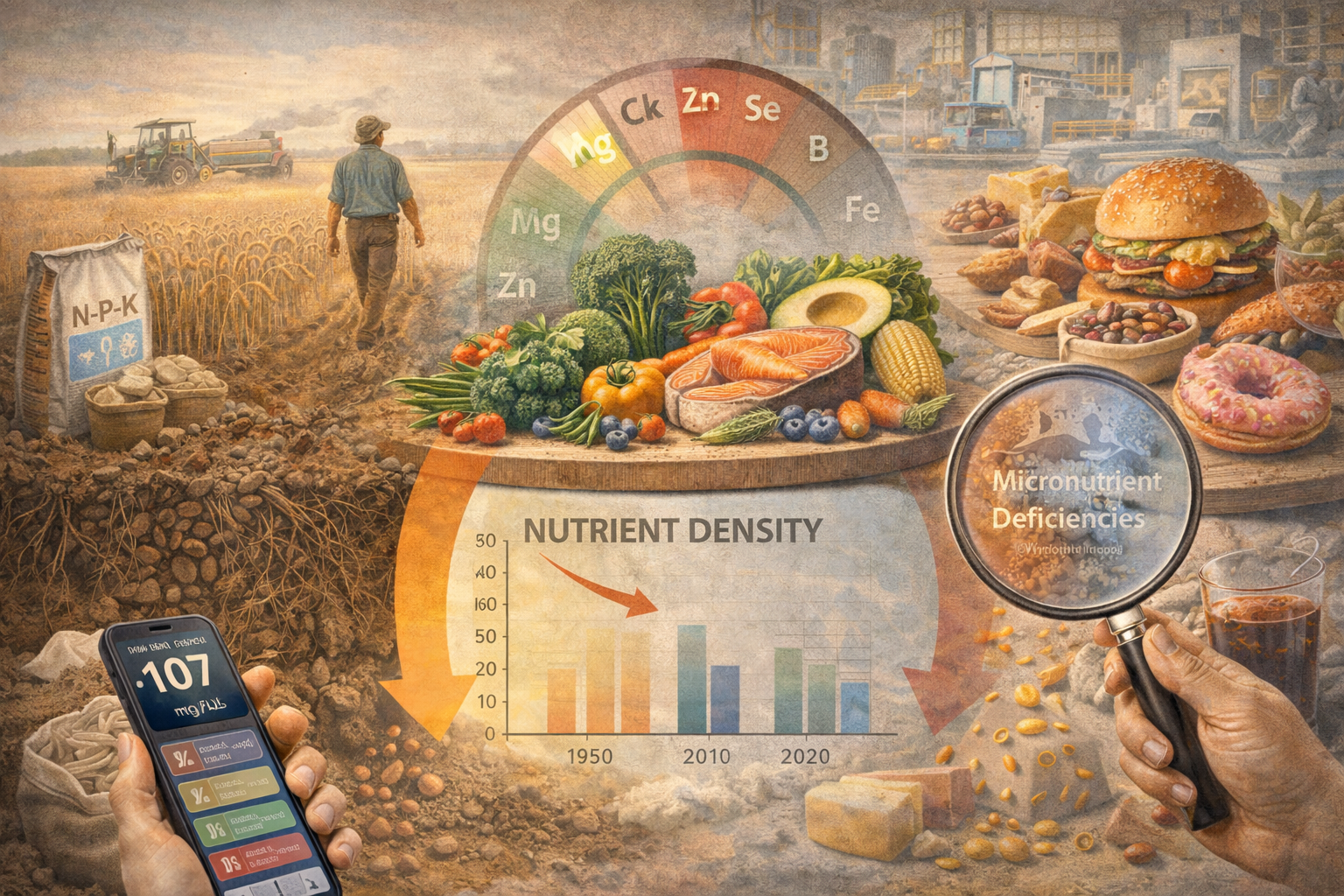
Over the past century, global food production has become remarkably efficient. Crop yields have increased, supply chains have expanded, and food has become more accessible to more people than at any point in human history. Yet alongside this success, a quieter and less visible shift has occurred within the food system itself. Many researchers now point to a gradual but measurable decline in the micronutrient content of commonly consumed foods. This phenomenon, often described as micronutrient depletion, has become a growing concern within nutrition science.
The issue is not one of calorie scarcity. In fact, modern diets provide more calories than ever before. The problem lies in what those calories contain, or increasingly, what they lack. Vitamins, minerals, and trace elements essential for cellular function are present in lower concentrations in many modern foods compared to historical benchmarks. As a result, individuals can meet or exceed their energy needs while remaining undernourished at a micronutrient level.
Understanding how this shift occurred requires examining changes in agriculture, food processing, and dietary patterns, as well as how nutritional adequacy is measured in the modern era.
What Micronutrient Density Means
Micronutrient density refers to the concentration of vitamins and minerals per unit of food. Foods with high micronutrient density deliver essential nutrients such as magnesium, zinc, iron, selenium, and B vitamins relative to their caloric content. Historically, whole foods grown in nutrient-rich soils provided a broad spectrum of these compounds.
In contrast, foods low in micronutrient density may supply ample calories but relatively few essential nutrients. This distinction has become increasingly important as diets shift toward refined grains, added sugars, and industrially processed products.
Nutrition scientists emphasize that micronutrients play critical roles in enzymatic reactions, hormone regulation, immune defense, and mitochondrial energy production. Even marginal deficiencies can affect long-term health outcomes. When micronutrient density declines across the food supply, the cumulative effect can influence population-wide metabolic health.
Evidence of Micronutrient Depletion
Concerns about micronutrient depletion are not speculative. Multiple analyses comparing historical and modern food composition data have identified significant declines in certain nutrients. A widely cited study published in the Journal of the American College of Nutrition examined nutrient data for fruits and vegetables between 1950 and 1999 and found consistent reductions in protein, calcium, phosphorus, iron, riboflavin, and vitamin C.
Researchers attribute these changes to a phenomenon known as the dilution effect. As crops are selectively bred for higher yields and faster growth, the concentration of minerals absorbed from the soil may decrease. Larger plants do not necessarily accumulate proportionally more micronutrients, resulting in lower nutrient density per serving.
Further discussion of this effect can be found in agricultural research summarized by scientific institutions such as the National Institutes of Health, which note that yield-focused farming practices may unintentionally compromise nutrient concentration.
Soil Health and Agricultural Practices
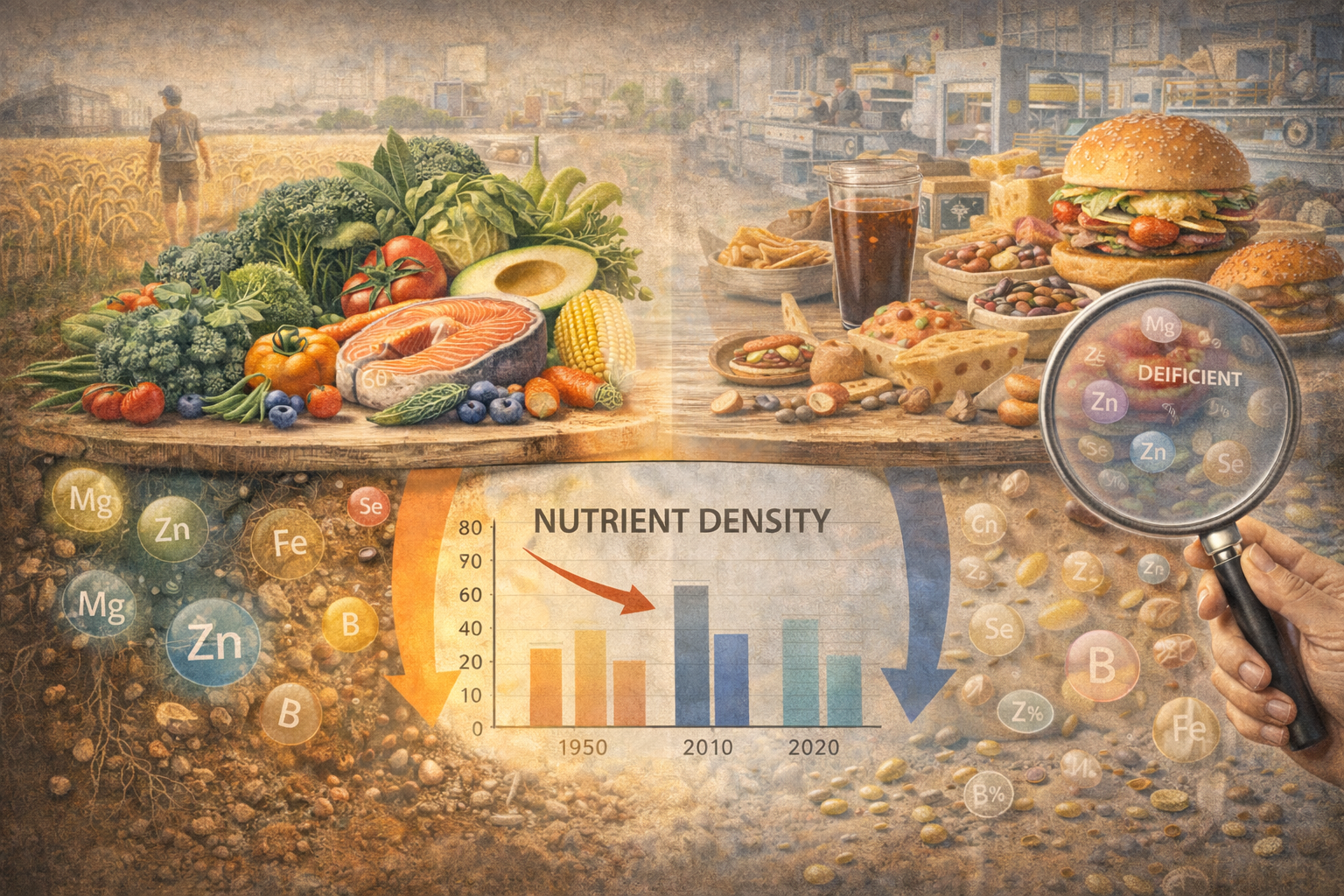
One of the most significant drivers of micronutrient depletion lies beneath the surface. Soil health has changed dramatically due to intensive farming methods. Repeated monocropping, synthetic fertilizers, and reduced use of crop rotation have altered the mineral composition of agricultural soils.
While modern fertilizers supply nitrogen, phosphorus, and potassium efficiently, they often do not replenish trace minerals such as zinc, selenium, copper, and magnesium. Over time, soils become less biologically diverse and less capable of supporting nutrient-dense crops.
Regenerative agriculture advocates argue that restoring soil microbiology and mineral balance is essential for improving food nutrient content. Studies cited by the Food and Agriculture Organization of the United Nations suggest that soil degradation is now a global issue, affecting both crop resilience and nutritional quality.
Processing and Refinement
Beyond agriculture, food processing plays a central role in reducing micronutrient availability. Refining grains removes bran and germ layers, where many vitamins and minerals are concentrated. Similarly, industrial processing often involves heat, oxidation, and chemical treatments that degrade sensitive nutrients.
Although some processed foods are fortified to compensate for these losses, fortification typically targets a limited set of nutrients and does not replicate the complexity of whole-food nutrient profiles. Nutrition scientists frequently point out that isolated vitamins added back into food do not behave identically to nutrients consumed in their natural matrix.
As a result, diets high in processed foods may technically meet recommended intake levels for certain vitamins while still lacking critical cofactors and trace elements needed for optimal physiological function.
Modern Diets and Hidden Deficiencies
One of the most paradoxical outcomes of modern food systems is the coexistence of overconsumption and undernutrition. Individuals may consume sufficient calories, protein, and even fortified nutrients while still experiencing functional deficiencies.
Micronutrient depletion at the food system level compounds this issue. When staple foods contain fewer minerals and vitamins, the margin for error narrows. Dietary variety becomes more important, yet modern eating patterns often reduce diversity rather than increase it.
Nutrition surveys conducted in high-income countries consistently show suboptimal intake of magnesium, potassium, vitamin D, and zinc across large segments of the population. These deficiencies are rarely severe enough to cause acute disease, but they may contribute to chronic fatigue, impaired immune response, and metabolic dysfunction over time.
Implications for Metabolic Health
Micronutrients are deeply involved in metabolic regulation. Minerals such as magnesium and chromium influence insulin sensitivity, while B vitamins support mitochondrial energy production. When these nutrients are insufficient, metabolic efficiency declines.
Educational resources on metabolic health, including those found on Dr. Berg’s blog, often emphasize the role of micronutrients in supporting fat metabolism, hormone balance, and cellular repair. From this perspective, micronutrient depletion is not merely a nutritional concern but a systemic metabolic one.
As metabolic disorders become more prevalent worldwide, attention is increasingly turning toward foundational nutritional adequacy rather than calorie balance alone.
Measuring Nutrition in a Changing Food Landscape
Another challenge lies in how nutrition is assessed. Food composition databases are often based on averaged nutrient values that may not reflect real-world variability. Soil quality, farming practices, and storage conditions can all influence nutrient content, yet these factors are rarely captured in dietary guidelines.
Moreover, recommended daily allowances are designed to prevent deficiency diseases rather than optimize metabolic function. In a food environment affected by micronutrient depletion, meeting minimum standards may not be sufficient to support long-term health.
This gap between adequacy and optimization is becoming a central topic in contemporary nutrition science discussions.
A Systemic Issue, Not an Individual Failure
It is important to recognize that micronutrient depletion is not primarily the result of individual dietary choices. It is a systemic issue shaped by agricultural policy, economic incentives, and industrial food production.
While personal food selection can mitigate some effects, the broader decline in nutrient density reflects structural decisions made over decades. Addressing the problem requires collaboration between farmers, researchers, policymakers, and public health institutions.
Interest in soil regeneration, diversified cropping systems, and minimally processed foods reflects a growing awareness that nutritional quality begins long before food reaches the plate.
Looking Forward
The decline of micronutrient density in modern food systems highlights a fundamental tension between efficiency and nourishment. As food production has become optimized for yield, shelf life, and cost, nutritional complexity has often been deprioritized.
Nutrition science is now revisiting assumptions made during the industrialization of food. Rather than asking only how much food is produced, the focus is shifting toward what that food provides at a cellular level.
Micronutrient depletion serves as a reminder that human health is inseparable from ecological health. Restoring nutrient density may ultimately depend on rethinking how food is grown, processed, and valued. In that sense, the conversation around micronutrients is not just about nutrition. It is about redefining what progress in food systems truly means.